
Local GNSS Augmentation for Urban Air Mobility: U-GBAS
U-GBAS provides local GNSS augmentation to support safe and precise navigation for unmanned aircraft operating in Urban Air Mobility.
Motivation
GNSS standalone does not meet the accuracy requirements for Urban Air Mobility. The Ground Based Augmentation System (GBAS) is an established means of providing accuracy and integrity in aviation, but its hardware is not suitable for UAM integration. UAM operations — take-off and landing at vertiports as well as safe separation en route — demand reliable, integrity-capable positioning, while urban environments degrade GNSS through multipath and limited satellite visibility. A cost-effective, scalable augmentation approach is therefore needed to enable the safe integration of UAM into future urban airspace.
Concept
U-GBAS is a concept for local GNSS augmentation derived from the established GBAS in civil aviation. It provides reliable and accurate GNSS measurements for integration into a redundant, safe and reliable integrated navigation architecture tailored to Urban Air Mobility (UAM) — in particular for take-off and landing operations at vertiports and for safe separation of UAM vehicles en route. By using less expensive hardware than traditional GBAS, the concept makes integration into future urban airspace easier and more cost-effective, both in terms of ground infrastructure demands and on-board navigation hardware.
The cornerstone of the concept is its integration with other navigation methods (e.g. INS, barometric sensors, cameras), yielding a multisensory solution that includes integrity information. Preliminary UAV flight trials in realistic urban scenarios (flights near and between office buildings and near a major bridge in Hamburg) as well as long-term rooftop measurements yielded promising initial results.
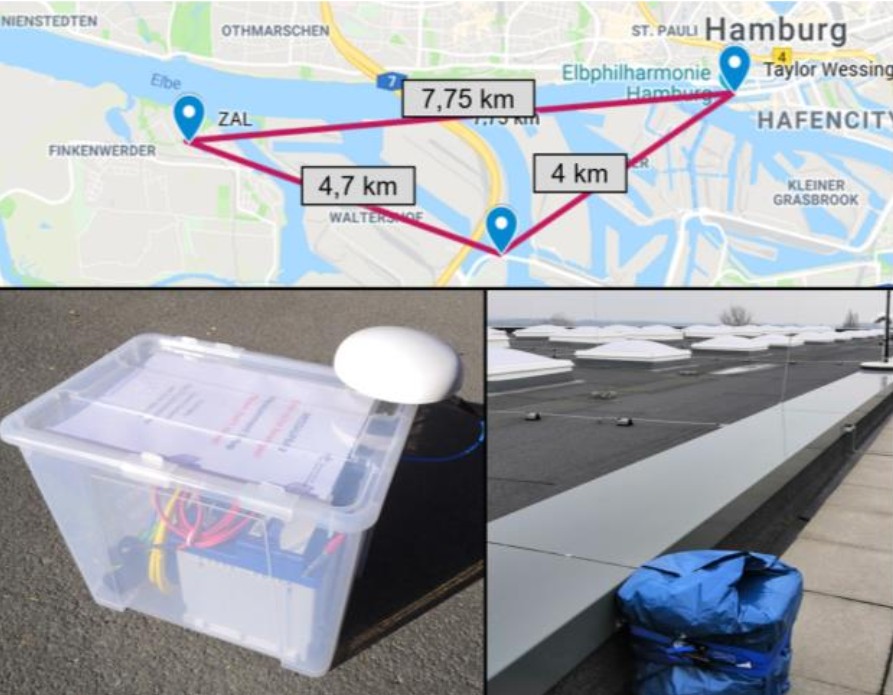
U-GBAS Ground station hardware prototype Version 1
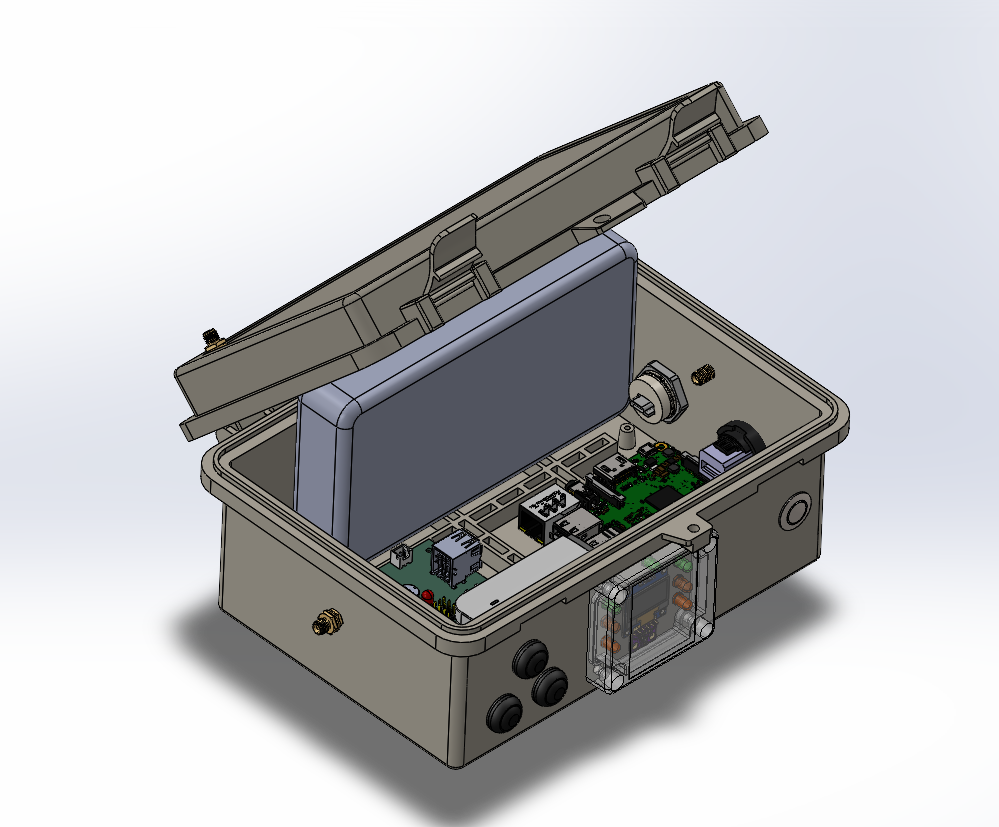
Currently under development: an improved version of the U-GBAS ground station receiver featuring:
- Distributed internal (pre-)processing capability (Raspberry-Pi based)
- Multi-frequency Multi-Constellation GNSS receiver (L1/L5, GPS+GAL+BDS)
- Connectivity to central processing facility / U-Space service over LTE, Wi-Fi or Ethernet
- Real-time monitoring (local and remote)
- Optionally battery / solar-powered for remote operations
- Optional integration of barometric sensors to support the Vertical conversion service